
REFORMER PILATES 6 min read
Reformer Pilates is the centre of J Pilates — not a side class squeezed into a gym timetable. If you have only seen the machine in photographs, it can look technical. In the room, it is a moving platform with a clear purpose: to let you load the body with control.
This guide explains what the Reformer is, how a typical hour unfolds, and how beginners usually start at the Sanpada and Ghansoli studios. It is written for people who want a real picture of the work, not a list of miracle claims.
Quick answer
Reformer Pilates uses a sliding carriage and springs so you can train strength, mobility and body awareness with controlled resistance. At J Pilates the hour is about 50–60 minutes, taught for all fitness levels, in boutique rooms rather than a crowded multi-sport floor.
What is Reformer Pilates?
The Reformer is a bed-like frame with a carriage that rolls along rails. Springs attach the carriage to the frame. When you push or pull, the springs either assist or resist, depending on the exercise and the spring setting.
Joseph Pilates designed apparatus so that movement could be organised — not thrown. The Reformer is the piece most people mean when they say they “do Pilates on a machine.” Mat Pilates uses the same principles on the floor. Reformer work adds hardware: a footbar, straps, a moving platform and changeable spring tension.
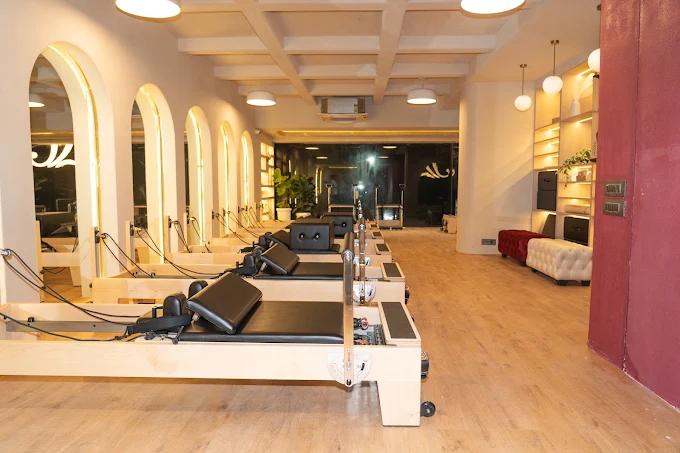
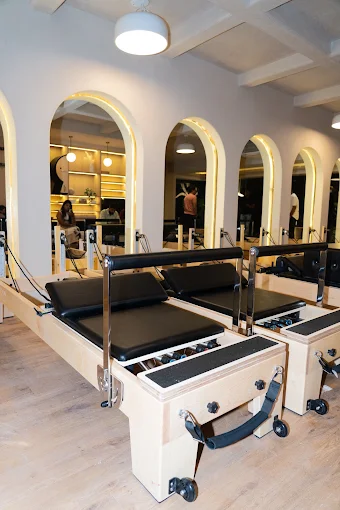
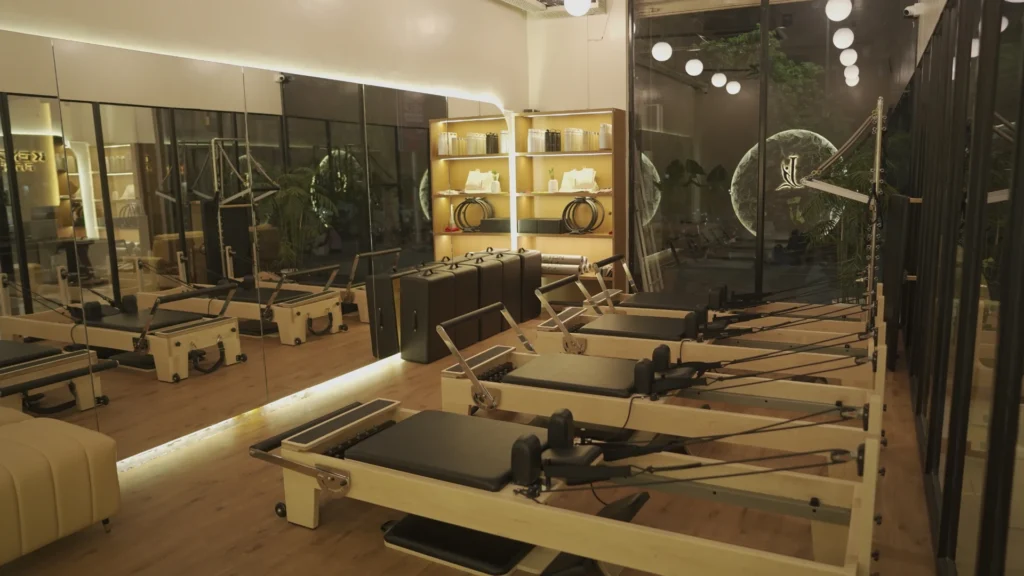
At J Pilates Reformer sessions, that hardware is the room. Sanpada photographs show a row of wooden reformers under arched lighting. Ghansoli photographs show reformers facing a logo wall. Both are purpose-built for this method.
How the equipment works
Think of the carriage as a moving floor. You might lie on it, sit, kneel or stand, depending on the sequence. Your feet may press the footbar. Your hands may hold straps. The springs decide how heavy or how supported the path feels.
Heavier spring settings are not automatically “harder,” and lighter settings are not automatically “easier.” A light spring can demand more stability because the carriage travels more freely. A heavier spring can give you something to push against. Instructors choose settings for the exercise and for the person in front of them.
- Carriage — the moving platform you work from.
- Springs — the source of resistance and support.
- Footbar — a stable place to press, often with the feet.
- Straps and ropes — connections for arms or legs.
- Shoulder blocks and headrest — references for lying work.
You do not need to memorise the parts before you arrive. Cueing is the instructor’s work. Your job is to listen, breathe and stay with the range you are given.
What a typical session involves
A J Pilates hour is approximately 50–60 minutes. The exact sequence changes, but the shape is usually consistent: you are set up on the reformer, you move through a series of controlled exercises, and you finish with enough time to leave the carriage organised rather than rushed.
You will not be asked to sprint. The tempo is slower than many group fitness rooms. That slowness is not a lack of work. Moving slowly with springs still loaded is how the method asks for strength without throwing the joints.
What happens during a Pilates class?
After a brief check-in, you take a reformer. The instructor sets springs and explains the first position. You work through sequences for legs, back, arms and centre, with rest where it is useful. In a small group you still receive individual notes. In a private session the entire hour is built around one body.
Is Reformer Pilates suitable for beginners?
Yes. J Pilates states that sessions are designed for all fitness levels, including first-time reformers.
Beginners often worry that they will hold a class back. The Reformer is actually a helpful first tool because springs can support you while you learn where to place your feet and how far to travel. You are not expected to arrive fluent.
If the machine still looks intimidating, start with a private session. One instructor, your pace, time to ask what a spring colour means. Group classes remain small-batch in spirit; they are not a stadium format.
Read the companion piece Is Pilates good for beginners? if you want clothing, nerves and first-class logistics in one place.
Why people choose Reformer work
People come to Reformer Pilates for strength that does not rely on jumping, for mobility that is trained under load, and for a clearer sense of where the body is in space. J Pilates describes the work as core strength, posture, flexibility and moving with confidence. Those are training effects, not medical promises. Individual results vary.
Because the impact is low compared with running or plyometric classes, many people keep Reformer work as a long-term practice. It can sit beside walking, other sports or desk life. It is not required to replace everything else you do.
If you want the method contrasted with floor work, see Reformer Pilates vs Mat Pilates.
Private training or group classes
Private Reformer sessions give you the most space to learn setup. Group Reformer classes share a room and a sequence, with instructors still coaching individuals. Both exist at J Pilates. Neither is a crowded gym circuit.
Choose private if you are new, returning after time away, or you simply prefer one-to-one attention. Choose group when you already understand the carriage and want shared pace. You can move between formats as the weeks unfold.
Book through the J Pilates online platform. The same booking path is used for Sanpada and Ghansoli; choose the studio that fits your commute.
Common questions
How long is a Pilates session?
At J Pilates, each session lasts approximately 50–60 minutes.
That window includes setup and coached work. It is not an open-ended gym slot. Arrive ready to start so the hour stays intact.
How often should you do Pilates?
Two or three sessions a week is a common Reformer rhythm, with rest around it. The studio also notes at least eight sessions as a planning horizon for visible improvement — not a guaranteed aesthetic result.
A fuller frequency guide is How often should you do Pilates? and How to build a consistent routine.
Do I need to be flexible first?
No. Flexibility is something the work can develop. You start with the range you have and organise it.
If a position is unavailable, the instructor can change springs or choose another setup. That is ordinary teaching, not a special exception.
Is this the same as a gym class with a reformer in the corner?
J Pilates rooms are dedicated Reformer studios. The photographs of Sanpada and Ghansoli show rows of apparatus, not a mixed weights floor.
If you want to see the rooms, use the gallery before you book.
Practical guidance
Each J Pilates session lasts approximately 50–60 minutes. Wear comfortable activewear that allows free movement. Sessions can be rescheduled with at least 24-hour notice.
J Pilates recommends at least eight sessions for visible improvement. That is a planning note for how long it often takes to learn the work — not a guarantee of a specific result.
Trial pricing and package blocks are listed on the packages page. Compare rooms on the Sanpada studio and Ghansoli studio pages if commute will decide your week.
The founder’s view of intentional movement is on the Jyoti Singh page. Use it as context, then book the hour — the method lives on the carriage.
How Reformer work is taught at J Pilates
J Pilates is a boutique Reformer studio in Navi Mumbai, with rooms in Sanpada and Ghansoli founded by Jyoti Singh. The public offering is not a rotating menu of unrelated fitness trends. Reformer Pilates sits at the centre, with private training, small-group sessions, Wunda Chair, pre-natal and post-natal work, physiotherapy and InBody assessment around it.
That context matters when you ask what Reformer Pilates “is.” In this brand it is the default language of the room. Instructors teach springs, straps and the footbar as ordinary tools, the way a swimming coach treats a pool. You are not expected to have collected a vocabulary before you arrive.
Sanpada’s photographs show reformers under arched lighting and a lounge that is clearly a waiting room, not a cafe bolted onto a gym. Ghansoli’s photographs show a logo wall, a reformer row and small-group work. Both images tell the same story: this is apparatus practice in a finished boutique interior.
If you are comparing studios, look at whether the Reformer is the room or an accessory. J Pilates built the former. Book the trial if you want to test that claim in your own body rather than on a screen. Use the Reformer service page for the method overview and this article for the beginner-facing explanation.
People sometimes arrive hoping the machine will do the work for them. It will not. Springs change the feel; they do not replace attention. The useful surprise for many beginners is that a slower hour can still feel like training — because you are resisting the return, placing the feet, and keeping the ribs from flaring every time the carriage moves.
People also arrive afraid they will look unskilled. Almost everyone looks unskilled on a first Reformer. That is not a character flaw. It is a new coordination. The instructor’s job is to give you a path you can follow. Your job is to stay with that path for the 50–60 minutes in front of you.
When the first session ends, you will know more about whether you prefer private teaching or a shared sequence. You will also know which commute felt reasonable. Those two facts are enough to plan the next week. The rest — packages, eight-session notes, InBody — can wait until you have decided the room is yours.
FAQ
What is Reformer Pilates?
Reformer Pilates is controlled resistance training on a moving carriage opposed by springs. Straps, a footbar and the carriage let you organise arms, legs and centre in one system.
Is Reformer Pilates suitable for beginners?
Yes. J Pilates sessions are designed for all fitness levels. Springs can be set to support you while you learn setup and timing.
How long is a Pilates session?
About 50–60 minutes at J Pilates.
Where can I try Reformer Pilates in Navi Mumbai?
J Pilates teaches Reformer work in Sanpada and Ghansoli. Both rooms are dedicated apparatus studios.