

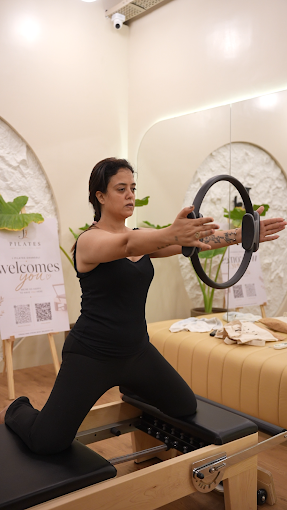
REFORMER PILATES 6 min read
People often ask whether they should “do Pilates on the mat or on the machine.” Both can be intelligent. They are not the same hour. The tools change the feel, the loading and how an instructor can help you.
J Pilates is a Reformer studio. This article explains the difference so you can book with clear expectations — not so we pretend every format is taught equally in every room.
Quick answer
Mat Pilates uses the floor and body weight. Reformer Pilates uses a sliding carriage and springs for changeable resistance and support. J Pilates in Sanpada and Ghansoli is built around Reformer work in boutique apparatus rooms.
What is the difference between Reformer and Mat Pilates?
The principles overlap — control, concentration, breath, alignment, flowing sequences. The equipment does not.
On the mat you organise against gravity and the floor. On the Reformer you organise against springs and a moving platform. That extra hardware can make an exercise more supported or more demanding, depending on the setting.
Mat classes can be excellent. They also require enough body awareness to hold shape without straps. Reformers give the instructor more ways to scale the same idea for a beginner or an experienced mover.
How the experience differs
Reformer sessions often feel more like precise resistance training. You press, pull and travel on rails. Mat sessions can feel closer to a movement class on the floor, sometimes with small props.
Neither is automatically “easier.” A long lever on a light spring can feel unstable. A well-set mat exercise can feel dense. The useful question is which environment helps you practise with attention.
Which format may suit you
- If you want changeable resistance and a dedicated machine studio, Reformer is the J Pilates offering.
- If you already have a strong mat practice, Reformer can add load and variety without turning the hour into high-impact training.
- If you are brand new, Reformer springs can help you find positions. Private teaching accelerates that learning.
For a full picture of the apparatus, read What is Reformer Pilates?.
What you will find at J Pilates
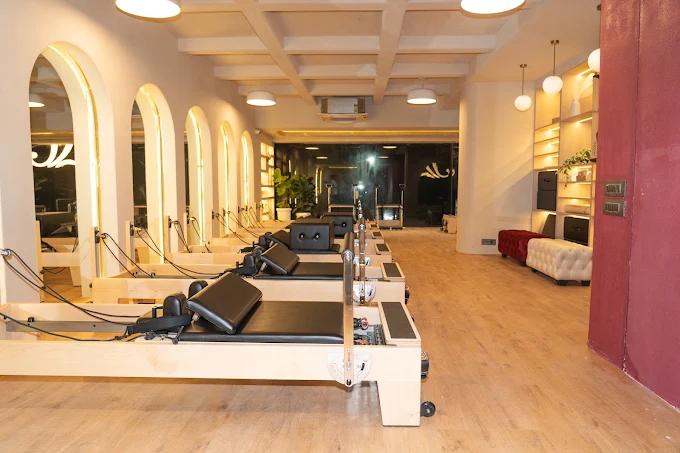
The Sanpada and Ghansoli rooms are photographed around reformers, not around a large open mat grid. Wunda Chair sits alongside as another apparatus. Group and private formats still centre on coached Reformer work.
Book Reformer Pilates when you want that environment. Compare group and private if you are choosing how much individual coaching you want in the hour.
Common questions
Can I do both mat and Reformer?
Many people do. J Pilates’ public rooms and photography are Reformer-centred, so book here when you want apparatus coaching in Sanpada or Ghansoli.
Is Reformer more advanced?
Not automatically. Springs can support a beginner. Advanced work exists on both mat and Reformer. Progression is in the teaching, not in the furniture alone.
Which should I book at J Pilates?
Book Reformer sessions. That is the studio’s core offering. Use the beginners and first-session guides if the machine is new to you.
Practical guidance
Each J Pilates session lasts approximately 50–60 minutes. Wear comfortable activewear that allows free movement. Sessions can be rescheduled with at least 24-hour notice.
Book through the J Pilates online platform. The same booking path is used for Sanpada and Ghansoli; choose the studio that fits your commute.
See the studio gallery if you want to look at the rooms before you decide. Packages are listed with verified prices on /packages/.
Choosing without turning it into a rivalry
Mat versus Reformer arguments online often sound like team sports. In a real week you might do both, or you might only ever do one. J Pilates is honest about which team it plays on: the rooms, the photographs and the service list are Reformer-centred.
That does not make mat work lesser. It makes this studio a bad place to shop if what you actually want is a large open mat class with no apparatus. Go where the room matches the practice.
If you already love mat Pilates, Reformer can feel like the same conversation with different grammar. Springs talk back. The carriage moves when your organisation fails. Some people find that feedback addictive. Some people prefer the quiet of the floor. Neither preference is a moral fact.
Beginners sometimes choose Reformer because the machine looks supportive, then discover that a light spring can feel like ice. That is useful information, not a trick. Ask the instructor to change the setting. Teaching is allowed to be conversational.
When you book at J Pilates you are booking coached Reformer time in Sanpada or Ghansoli. Use group or private to decide how many other bodies share the sequence. Use the gallery if you need to see the furniture before you trust the copy.
If a friend trains only on the mat, you can still talk about the same principles — control, breath, centre. You will simply have different homework. That is enough difference to respect, and not enough to turn into a debate about which is “real Pilates.”
FAQ
What is the difference between Reformer and Mat Pilates?
Both use Pilates principles. Reformer work adds a moving carriage and springs; mat work uses the floor and your body as the main resistance.
Which is better for beginners?
Neither is universally better. Reformer springs can support a first-timer. Mat work asks you to organise without that hardware. At J Pilates the rooms are built around Reformer practice.
Does J Pilates teach mat classes as the main format?
J Pilates is a Reformer-centred boutique studio. The public offering is organised around apparatus, private and group Reformer sessions, and related services.